Geotechnical Engineering in Hayward

Together, we solve the challenges of tomorrow.

LEARN MORE →

The flatlands and foothills of Hayward present a geotechnical puzzle that changes every half mile. One parcel sits on dense alluvial fan deposits washed down from the East Bay hills, while the next block over rests on compressible Bay Mud that can settle unevenly under structural loads. A comprehensive soil mechanics study cuts through that uncertainty, giving engineers the shear strength parameters, consolidation curves, and bearing capacity numbers they need before a single footing is poured. The City of Hayward requires geotechnical reports that address both static performance and seismic response, given that the Hayward Fault runs directly beneath the western edge of town. When we combine deep boring data with laboratory index testing, the resulting soil mechanics profile reveals exactly how the ground will behave during the structure’s design life, not just on day one of construction.

In Hayward, the difference between competent Merritt Sand and compressible Bay Mud can occur within fifty lateral feet—soil mechanics testing maps that transition precisely.
Geotechnical Engineering in Hayward
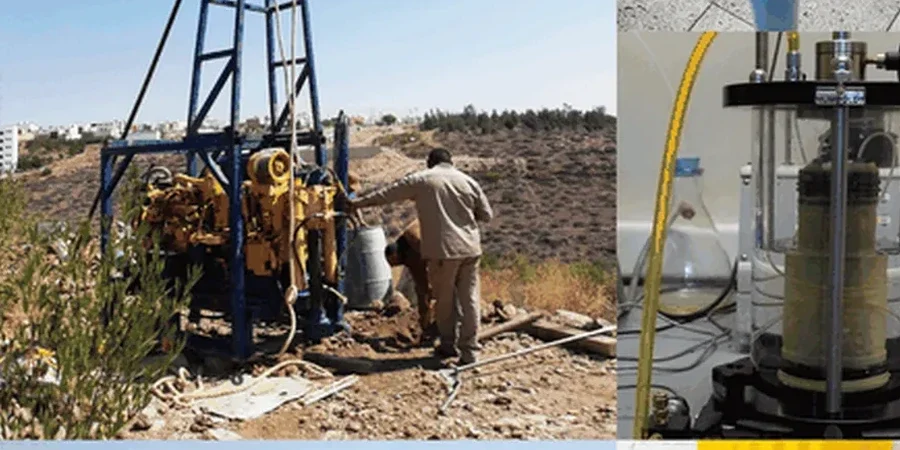
Technical reference image — Hayward

Our approach and scope

Hayward sits on a complex stack of Quaternary alluvium, Holocene Bay Mud, and Merritt Sand, all draped across an active strike-slip fault system. In our experience, the Merritt Sand—a Pleistocene-age unit that outcrops along the B Street corridor and toward the hills—provides competent bearing but often contains discontinuous silt lenses that complicate drainage calculations. A proper soil mechanics study must capture those transitions. We run consolidated-undrained triaxial tests on undisturbed Shelby tube samples to define effective stress envelopes for each stratum, and we pair that with Atterberg limits to classify the fine-grained layers per ASTM D2487. For sites near the Hayward Executive Airport, where shallow groundwater fluctuates seasonally, we also recommend grain-size analysis with hydrometer to understand how silt content affects permeability and potential for capillary rise beneath slab-on-grade construction.

Site-specific factors

What we keep seeing in Hayward is owners who commission a basic soil report with blow counts and surface observations, then skip the laboratory phase that quantifies settlement rate and magnitude. That works fine on dense Pleistocene gravels near the hills, but it backfires badly on the Bay Plain. We have reviewed projects along Huntwood Avenue where differential settlement between stiff alluvium and adjacent Bay Mud pockets required underpinning within five years of occupancy. A full soil mechanics study—with one-dimensional consolidation testing and time-rate settlement predictions—would have flagged that mismatch during design. The other recurring issue is underestimating long-term creep along the Hayward Fault zone. Even structures set back from the trace can accumulate tectonic distortion over decades, and our laboratory testing quantifies the soil stiffness needed to accommodate that movement without structural distress.

Need a geotechnical assessment?

Reply within 24h.

Email: info@geotechnicalengineering1.com

Technical parameters

ParameterTypical value
Effective friction angle (φ')28°–38° (varies by stratum)
Undrained shear strength (Su)500–2,500 psf (Bay Mud typical)
Compression index (Cc)0.15–0.45 (fine-grained soils)
Overconsolidation ratio (OCR)1.2–3.5 (upper Pleistocene deposits)
Liquidity index (LI)0.6–1.4 (near-surface clays)
Standard penetration resistance (N60)4–35 blows/foot
Soil unit weight (γ)95–130 pcf (saturated)

Complementary services

01

Laboratory Soil Mechanics Testing Suite

Triaxial shear (CU and CD), one-dimensional consolidation, direct shear, and Atterberg limits testing performed in our ISO 17025-accredited laboratory. We provide effective stress parameters, compression indices, and permeability coefficients for each soil unit encountered in Hayward borings.

02

Bearing Capacity and Settlement Analysis

Analytical and numerical modeling of shallow and deep foundation performance under static and seismic load combinations. We incorporate Hayward Fault proximity factors per ASCE 7 and deliver net allowable bearing pressures with total and differential settlement estimates for your structural engineer.

Applicable standards

ASTM D1586 – Standard Test Method for Standard Penetration Test (SPT) and Split-Barrel Sampling of Soils, ASTM D2487 – Standard Practice for Classification of Soils for Engineering Purposes (Unified Soil Classification System), IBC 2021 – International Building Code (adopted by City of Hayward with California amendments), ASCE 7-22 – Minimum Design Loads and Associated Criteria for Buildings and Other Structures, ASTM D4767 – Standard Test Method for Consolidated Undrained Triaxial Compression Test for Cohesive Soils

Questions and answers

What soil conditions in Hayward make a detailed mechanics study essential?

The main driver is the juxtaposition of Bay Mud, alluvial sands, and Pleistocene Merritt Sand across short distances, plus the Hayward Fault’s influence on seismic demand. Bay Mud can consolidate significantly under fill or structural loads, producing settlement that varies across a building footprint. A soil mechanics study quantifies shear strength, compressibility, and permeability for each layer so the design team can anticipate differential movement and select appropriate foundation systems.

How much does a soil mechanics study cost for a typical Hayward residential or commercial lot?

For a standard parcel in Hayward, a soil mechanics study combining field drilling, sampling, and the laboratory testing suite generally ranges from US$2,860 to US$5,400. The exact cost depends on boring depth, number of samples requiring triaxial or consolidation testing, and whether groundwater monitoring wells are required per City of Hayward conditions of approval.

Does the City of Hayward require a soil mechanics study or just a standard geotechnical report?

The City typically requires a geotechnical investigation that demonstrates compliance with the California Building Code, which references IBC and ASCE 7. For sites within the Alquist-Priolo Earthquake Fault Zone or areas underlain by Bay Mud, the reviewing building official often expects laboratory-derived soil mechanics parameters—not just field blow counts—to justify bearing capacity and settlement calculations. We coordinate directly with Hayward plan check to confirm the scope meets current submittal requirements.
Location and service area

We serve projects in Hayward and surrounding areas.

View larger map