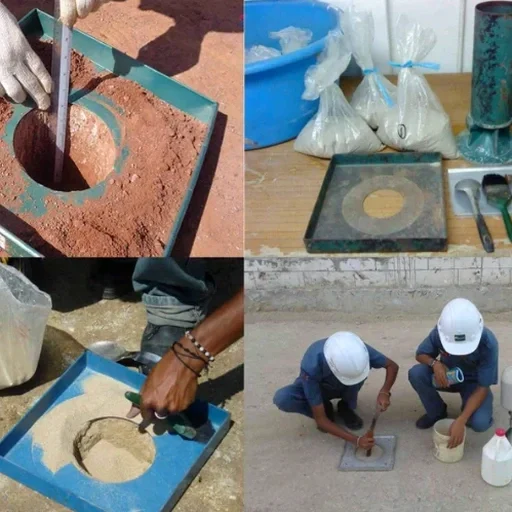
Hayward’s expansion from a salt-producing and agricultural hub into a dense East Bay logistics corridor meant thousands of square yards of compacted fill placed against the foothills and across the former marsh edges. Every lift of that fill has to meet a density spec, or the settlement shows up fast in a place that sits between the active Hayward Fault and the Bay. Our lab runs the ASTM D1556 sand cone test on active Hayward sites—Mission Boulevard commercial pads, industrial infill near the 880 corridor, and utility trench backfill through the B Street industrial district. We tie the density result directly to the Proctor curve from the same material, because without that reference the number means nothing. For deeper verification under proposed mat slabs, mat foundations often require cross-checking with undisturbed sampling to confirm that compaction extends below the top lift.
A sand cone test that takes 25 minutes and follows ASTM D1556 to the letter gives you a defensible compaction number—skip the calibration, and the number is just a guess.
Site-specific factors
The sand cone apparatus is low-tech—a one-gallon plastic jug, a metal cone with a valve, a base plate, and a can of graded Ottawa sand—but it demands methodical field discipline. Wind blowing across an exposed Hayward site can disturb the sand pouring process and introduce error. We set up behind a truck or use a windscreen when the afternoon breeze kicks up off the Bay. The test hole must be excavated carefully with a spoon and brush; if you gouge the sides, the volume measurement is compromised. Losing sand into cracks or voids in the base plate seal is the most common failure mode. On Hayward projects where fill contains brick fragments or concrete rubble from demolition, we switch to a rubber-base pad and excavate slowly. The lab runs a sand density calibration at the start and end of each field day because temperature and humidity shift the bulk density slightly, and a calibration drift of 0.5 pcf can push a borderline compaction result from pass to fail.
Questions and answers
How much does a sand cone density test cost in Hayward?
A single sand cone test on a Hayward site typically runs between US$110 and US$160 per point when we are already mobilized for a testing program. The rate depends on the number of tests per day, travel distance across the East Bay, and whether the Proctor curve already exists or needs to be developed by the lab.
What compaction standard does the City of Hayward require for building pads?
Hayward Building Division generally requires a minimum of 90 percent relative compaction per ASTM D1557 (modified Proctor) for structural fill beneath footings and slabs. The project geotechnical report may specify a higher percentage, typically 92 to 95 percent, particularly for fill supporting mat foundations or in areas with underlying compressible Bay Mud.
How deep does the sand cone test go?
The test hole depth matches the loose lift thickness placed by the contractor—usually 6 to 12 inches. We do not test through multiple lifts at once because the result must represent a single compacted layer. If the spec requires density verification deeper, we test each lift as the fill is placed.
What happens if the density test fails?
We report the failing result immediately to the contractor and the geotechnical engineer. The typical remedy is additional passes with the compactor, moisture conditioning if the fill is too dry or too wet, and a retest. If the material itself is the problem—too much clay, debris, or oversize rock—the engineer may require removal and replacement with select fill.
Can you use the sand cone method on aggregate base under asphalt?
Yes, the sand cone method works well on aggregate base, provided the maximum particle size does not exceed 2 inches. We use the larger 6-inch cone and base plate for coarse aggregate, and we run a lab Proctor on a representative sample of the base material to establish the compaction target before field testing begins.