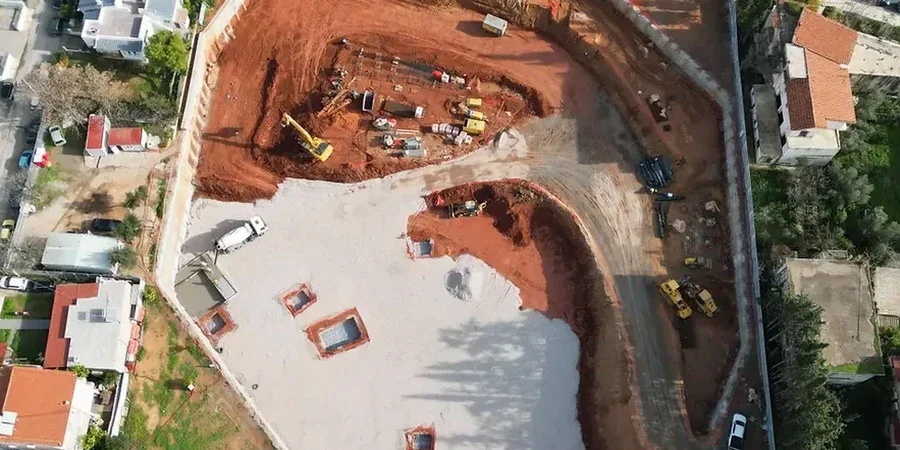
Hayward sits at an elevation of about 105 feet, but the real depth that matters here runs along the Hayward Fault trace right beneath Mission Boulevard. With a population exceeding 160,000, the city straddles one of the most active seismic zones in the country. Any deep excavation in Hayward must account for more than just soil mechanics. The design needs to handle the kinematic demands of a creeping fault, the unpredictable behavior of alluvial deposits overlying Franciscan bedrock, and groundwater that fluctuates with the nearby San Francisco Bay. We use site-specific data from CPT testing to profile the stratigraphy without disturbing sensitive bay mud samples, and pair that with MASW surveys to map the shear wave velocity profile for accurate deformation analysis. This integrated approach ensures the excavation support system remains serviceable through both static and seismic loading conditions.
Designing the bottom of an excavation in Hayward means checking base heave against a creeping fault that adds tectonic lateral strain to every strut.
Site-specific factors
Hayward’s urban fabric expanded rapidly after the 1868 Hayward earthquake, which ruptured the fault from San Leandro to Fremont. Much of the downtown grid was rebuilt on debris fill and alluvium without modern grading codes. Today, an excavation adjacent to a 1920s unreinforced masonry building presents a dual risk: structural collapse from loss of lateral support, and sudden ground displacement triggered by fault aseismic creep. The 1989 Loma Prieta event reawakened awareness that bay margin sites amplify long-period motions. A deep excavation without adequate tiebacks or bracing can experience incremental movement during a moderate tremor, accumulating damage that leads to a sudden failure during the next aftershock. Our designs incorporate a reserved capacity factor specifically for fault-normal displacement, something generic shoring manuals overlook. We also require pore pressure transducers at multiple depths to detect any undrained loading before it manifests as a surface settlement.
Questions and answers
How does the Hayward Fault affect deep excavation design compared to other Bay Area cities?
The Hayward Fault is a creeping fault, meaning it accumulates tectonic strain continuously rather than only during large events. For a deep excavation, this introduces the need to design the bracing system for a sustained lateral displacement demand, not just a cyclic seismic load. We incorporate a fault-normal drift component into the structural analysis of the shoring, something not required in cities farther from the fault trace like Oakland or San Jose.
What is the typical cost range for the geotechnical design of a deep excavation in Hayward?
For a complete design package including field investigation planning, laboratory testing oversight, shoring calculations, dewatering design, and sealed construction documents, the engineering fee typically ranges from US$1,800 for a smaller single-family lot excavation to US$7,720 for a multi-story commercial basement requiring tieback anchors and continuous vibration monitoring.
How do you handle the high groundwater table in the Hayward basin?
We design a depressurization system that often combines deep wells with a vacuum assist in the silty layers. The target is to maintain the water level at least 3 feet below the excavation subgrade at all times. The well pumps are sized based on in-situ permeability tests, and we include a backup generator requirement in the specifications to prevent a sudden rise that could destabilize the base.
What information do you need from the owner to start the deep excavation design?
We need the architectural basement plan, the property boundary survey, and any information about adjacent underground utilities. We also review the local jurisdiction's requirements, as Hayward may have specific conditions for shoring adjacent to the public right-of-way along corridors like Foothill Boulevard.