← Home · Foundations

Pile Foundation Design in Hayward: Deep Support for Challenging Bay Soils

Together, we solve the challenges of tomorrow.

LEARN MORE →

We have seen foundation plans for Hayward projects that specify shallow footings on a site where the top 30 feet are soft, compressible Bay Mud. The result is always the same: excessive settlement, cracked slabs, and an urgent call for a retrofit that triples the original cost. The error stems from treating a marginal soil profile as if it were competent ground, which is a gamble no contractor should take east of the Hayward Fault. Pile foundation design bypasses unstable near-surface layers by transferring structural loads to dense, competent strata at depth, typically the Pleistocene alluvium or deeper Franciscan bedrock that underlies much of the city. Our laboratory, accredited under ISO 17025, integrates field data from SPT and CPT soundings performed across Hayward's alluvial plain to develop axial capacity curves that reflect actual stratigraphy, not textbook assumptions.

A pile group analysis that misses the kinematic interaction between soft clay and stiff piles during a Hayward Fault earthquake will underestimate bending moments by 40% or more.

Our approach and scope

The 2024 California Building Code (CBC), which adopts the IBC with state amendments, requires deep foundations through soft soils where settlement exceeds tolerable limits—a condition that applies to large portions of Hayward, particularly west of Mission Boulevard. Our design process for pile foundation design addresses both geotechnical and structural limit states defined in ASCE 7-22 Chapter 12, verifying that pile groups resist inertial forces amplified by the site's Seismic Design Category D. We determine pile type, diameter, and embedment length by analyzing unit skin friction in dense sand lenses and end bearing on gravelly deposits, often using data from a CPT test to refine the stratigraphic profile without sample disturbance. For projects within the Alameda County Flood Control District, we also evaluate scour potential at creek crossings and design pile caps that remain stable under the 100-year flow event.
Pile Foundation Design in Hayward: Deep Support for Challenging Bay Soils
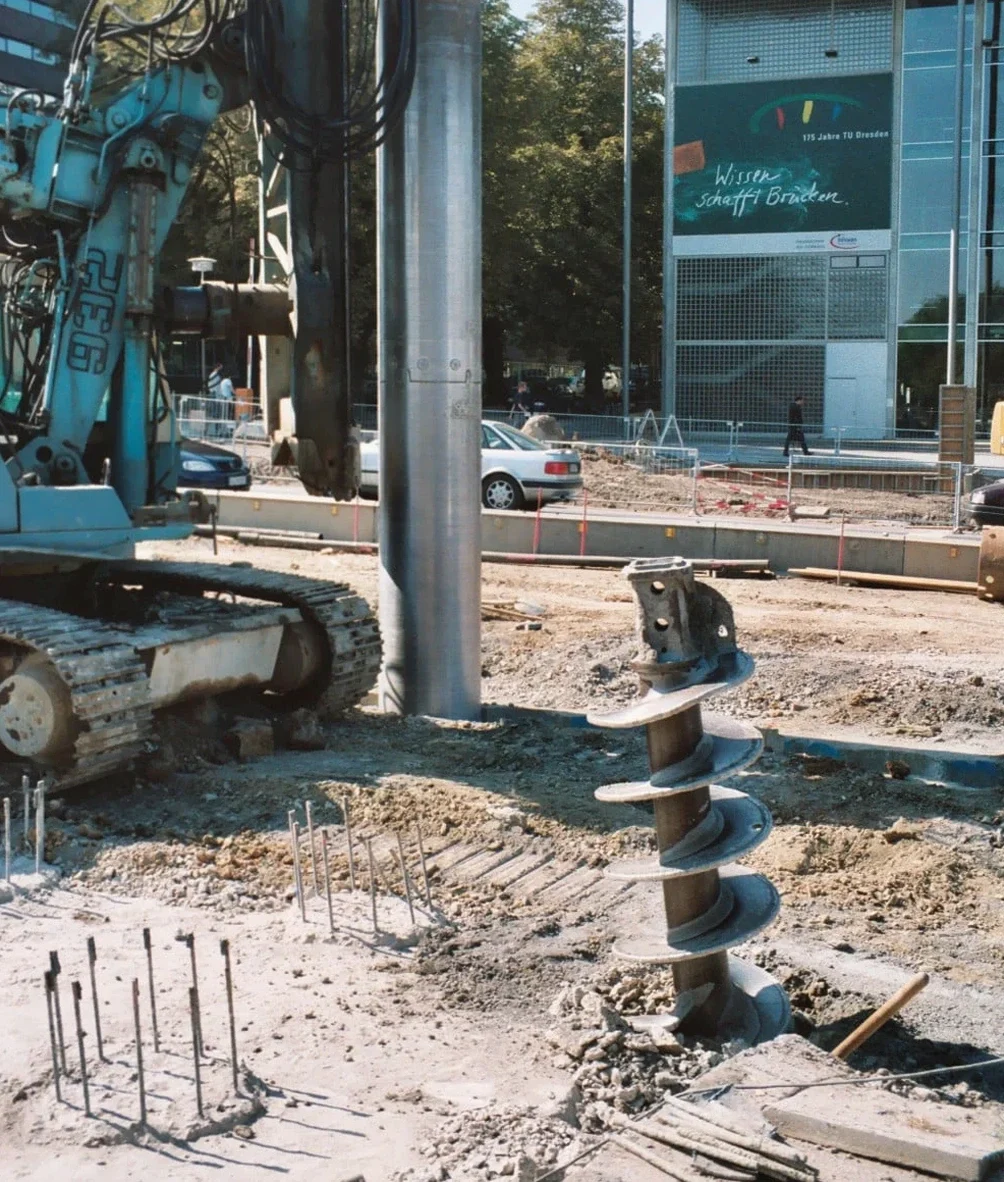
Technical reference image — Hayward

Site-specific factors

We bring a track-mounted CME-75 drill rig onto Hayward sites to advance borings through the Young Bay Mud, a plastic clay unit that blankets much of the flatlands with undrained shear strengths often below 300 psf. The rig's automatic hammer system delivers consistent SPT blow counts down to depths exceeding 80 feet, penetrating the transition zone where interbedded silts and sands mark the top of the Alameda Formation. Our field team logs every core run because we know that a thin sand seam at 45 feet can provide enough skin friction to eliminate the need for a larger pile diameter. The most serious risk is not soft clay but the liquefaction of loose saturated sands during a Hayward Fault rupture; without a pile foundation design that accounts for post-liquefaction lateral spreading loads, the structure can displace several feet even if the pile itself does not fail structurally.

Need a geotechnical assessment?

Reply within 24h.

Email: info@geotechnicalengineering1.com

Technical parameters

ParameterTypical value
Design Code2024 CBC / IBC, ASCE 7-22
Pile TypesDriven HP steel, drilled CIDH, micropiles
Target Strata (Hayward)Pleistocene alluvium, Franciscan bedrock
Lateral Load AnalysisLPILE / GROUP, p-y curves
Settlement Criteria≤ 1 inch total, ≤ 0.5 inch differential
Seismic Design CategoryD (per ASCE 7-22 Chapter 11)
Standard Penetration TestASTM D1586 for skin friction correlation

Complementary services

01

Axial Capacity and Settlement Analysis

Static analysis of driven and drilled piles using SPT/CPT data calibrated to Bay Mud properties. We compute unit side friction and end bearing resistance, then apply t-z and q-z load-transfer models to predict overall settlement under service loads.

02

Lateral and Seismic Pile Design

Response of pile groups to Hayward Fault scenario earthquakes using nonlinear p-y springs in LPILE. We evaluate kinematic pile-head moments, group effects, and the stability of battered piles in sloping ground near the Hayward hills.

03

Construction Inspection and Load Testing

On-site monitoring of drilled shaft installation, including base cleanliness verification and concrete placement. We specify and interpret high-strain dynamic testing per ASTM D4945 and static load tests per ASTM D1143 to confirm design capacity.

Applicable standards

ASCE 7-22 – Minimum Design Loads and Associated Criteria, 2024 IBC / CBC Chapter 18 – Soils and Foundations, ASTM D1586 – Standard Penetration Test (SPT), ASTM D1143 – Pile Load Test Procedures, FHWA-NHI-16-009 – Drilled Shaft Design

Questions and answers

At what depth do piles typically find competent bearing in Hayward?

It depends on the site location relative to the Bay margin. West of the railroad tracks, piles often extend 70 to 90 feet to reach dense Pleistocene alluvium or bedrock. East of Mission Boulevard, on the alluvial fan slopes, competent gravelly layers can appear at 30 to 50 feet. We determine the exact tip elevation after correlating our SPT blow counts and CPT tip resistance with the published geologic maps of the Alameda Formation.

What type of pile is most suitable for the Bay Mud conditions here?

Driven H-piles and closed-end pipe piles perform well because they displace the soft clay and develop reliable skin friction. For sites with shallow groundwater or vibration restrictions, we specify drilled CIDH piles with temporary casing through the mud layer. In hillside areas where access limits rig size, micropiles drilled with down-the-hole hammers offer a practical alternative that achieves high bond stress in weathered rock.

How much does a pile foundation design for a Hayward project cost?

The design fee for a pile foundation system in Hayward ranges from US$1,430 for a straightforward single-pile replacement analysis to US$7,120 for a full group design on a commercial site requiring lateral spread assessment. The final cost depends on the number of piles, the complexity of the soil profile, and whether we need to run dynamic load tests to confirm performance.

Does the Hayward Fault proximity require special design considerations?

Yes, absolutely. The Hayward Fault runs through the city, placing most sites in Seismic Design Category D. Our pile foundation design explicitly accounts for the kinematic interaction between the soft clay layer and the stiff pile shaft during strong shaking. We calculate bending moments induced by the contrast in stiffness and verify that the structural section can resist those moments without yielding.

Can you design pile foundations for a residential addition on a hillside lot?

Yes. Many Hayward hillside properties have shallow bedrock or steeply dipping colluvium that makes spread footings impractical. We design drilled or driven piles that anchor into the stable Franciscan Complex bedrock, often paired with tie-down anchors if the slope exceeds 20 percent. Our reports address both the City of Hayward building requirements and the geomorphic constraints of the site.
Location and service area

We serve projects in Hayward and surrounding areas. More info.

View larger map