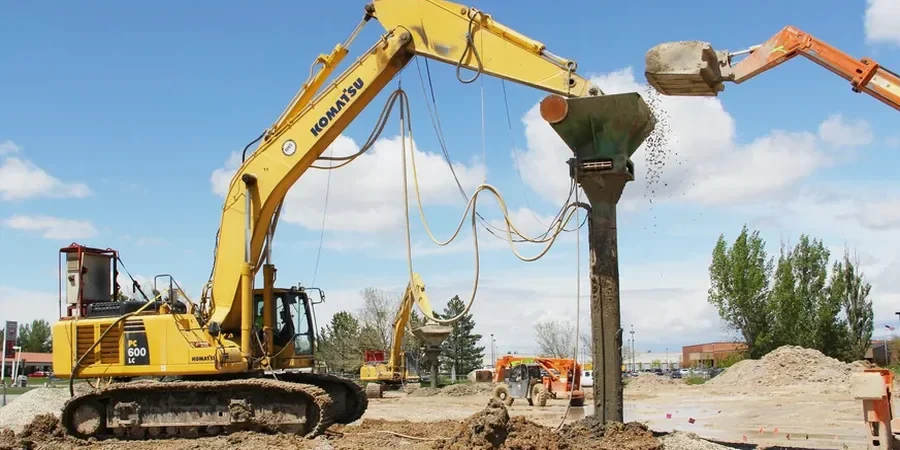
Hayward sits on a deep basin of Quaternary alluvium, much of it loose sandy deposits washed down from the East Bay hills over millennia. The water table here is high, often just 6 to 12 feet below grade, and with the Hayward Fault running right through the center of town, every project involves a seismic conversation. That combination of loose sand, shallow groundwater, and high seismicity makes vibrocompaction one of the most effective ground improvement methods we deploy. But the design side is where it gets real. Spacing, depth, energy input, and verification sequencing all have to be calibrated to the specific gradation of the site—you can't just copy a program from San Jose and expect it to work here. We start with the CPT test to map continuous tip resistance and friction ratio across the footprint, which gives us the baseline for densification targets. Where access allows, we supplement with test pits to visually confirm layering before mobilizing the vibrator.
Vibrocompaction design in Hayward is a seismic mitigation strategy, not just a density improvement exercise.
Our approach and scope
Hayward's development history left a patchwork of fill conditions. The old downtown corridor along B Street and the industrial zones near the 880 corridor sit on variable fills placed before modern compaction standards existed. We see clean sands, silty sands, and occasional clay lenses all within the same block. A vibrocompaction design has to account for that variability. Our approach uses the vibro replacement concept when fines exceed 15%, switching to stone feed that builds compacted columns rather than relying on pure densification—a technique closely related to stone columns but with different design parameters for spacing and load transfer. For cleaner sands below 5% fines, we design for 70-80% relative density, verified by post-treatment CPT with ASTM D1586 cross-checks at 10% of points. The Hayward Municipal Code references IBC 2022 and ASCE 7-22 for seismic ground motion, so our settlement and liquefaction analyses tie directly to those spectra rather than generic assumptions.
Questions and answers
How much does vibrocompaction design cost for a Hayward project?
For most Hayward commercial and industrial sites, vibrocompaction design and verification runs between US$1,400 and US$4,750 depending on footprint size, number of CPT soundings required, and whether we are designing for settlement reduction alone or full liquefaction mitigation under ASCE 7-22.
Does Hayward's proximity to the fault change the design approach?
Absolutely. The Hayward Fault produces near-field ground motions with strong vertical components and short-duration pulses that behave differently than distant subduction zone earthquakes. Our design acceleration spectra come directly from the USGS hazard tool at the site coordinates, not from generic maps, and we often need higher relative density targets than what a standard settlement-control design would call for.
What soils in Hayward respond best to vibrocompaction?
The clean to slightly silty sands of the alluvial fan deposits, typically with less than 10 to 12% fines. Once you get above 15% silt content, the pore pressure dissipation during vibration slows down and pure densification becomes inefficient—at that point we shift the design toward vibro replacement with stone columns.
How do you verify the ground improvement actually worked?
We run a CPT grid after treatment, typically at 50-foot spacing, and compare tip resistance and sleeve friction profiles directly against the pre-treatment baselines. For every ten CPT soundings, we perform one SPT to correlate with ASTM D1586 N-values. The acceptance criteria are written into the design report: minimum relative density, maximum allowable settlement under design load, and factor of safety against liquefaction at each depth increment.