← Home · Investigation

Exploratory Test Pit Investigation in Hayward, CA

Together, we solve the challenges of tomorrow.

LEARN MORE →

Hayward sits squarely on its namesake fault, and in 2023 the USGS updated the probability of a major rupture here to 33% within the next 30 years. Anyone breaking ground in this city, from the hillside lots above Cal State East Bay to the flatlands near the San Mateo Bridge approach, needs a direct look at what lies beneath. An exploratory test pit does exactly that: it opens a window into the soil profile so an engineer can log stratigraphy, check for fill, and spot lenses of bay mud that seismic shaking can turn into a problem. In our experience across Alameda County, combining test pit observations with a CPT test gives a near-continuous profile where the clay is too soft for SPT-driven numbers to stand alone.

You cannot out-calculate a missing soil lens; with a test pit you walk down and touch it.

Our approach and scope

IBC Chapter 18 and ASCE 7-22 set the baseline for subsurface exploration, but in Hayward the real driver is the fault proximity. We log every test pit per ASTM D2487, classifying soils by the Unified System, and we pay special attention to moisture and plasticity because the dry summer clay that cracks open in July behaves nothing like the saturated version a winter storm delivers. For deeper bearing layers beyond what a pit reveals, we often pair the work with SPT drilling to get blow counts and undisturbed samples from 10 to 30 feet down. A typical pit here reaches 8 to 14 feet, shored with a trench box when we go past 5 feet, and we document everything with scaled photos and GPS-tagged logs tied to the parcel boundary.
Exploratory Test Pit Investigation in Hayward, CA
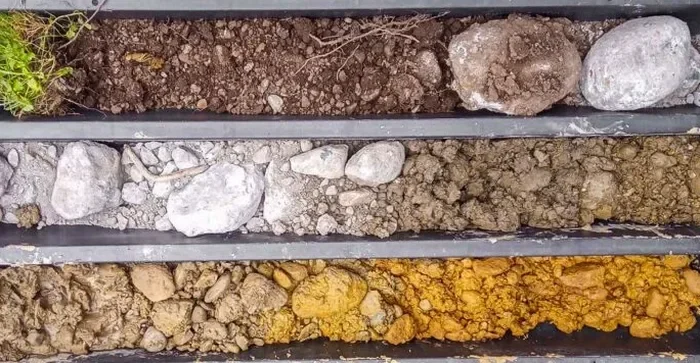
Technical reference image — Hayward

Site-specific factors

What we consistently see in Hayward is undocumented fill from the post-Loma Prieta rebuilds; old foundations get buried, creek channels get plugged with debris, and a clean-looking lot turns out to be sitting on six feet of brick and asphalt rubble. A test pit catches that immediately. The bigger risk is structural cracking from differential settlement when a footing spans two materials with sharply different stiffness, something a boring log alone can miss if the transition is lateral rather than vertical. We also watch for perched groundwater on hillside sites above Mission Boulevard: a thin sand seam carrying water can destabilize a cut slope within hours of exposure.

Need a geotechnical assessment?

Reply within 24h.

Email: info@geotechnicalengineering1.com

Technical parameters

ParameterTypical value
Maximum depth (unshored)5 ft per OSHA Subpart P
Typical pit dimensions4 ft wide × 8-14 ft deep
Logging standardASTM D2487 (USCS classification)
Sampling methodBulk grab and block samples from pit walls
Shoring requirementTrench box or hydraulic shore beyond 5 ft
Groundwater notationDepth to seepage recorded every 2 ft
Backfill protocolLift-compacted native soil with 95% relative compaction

Complementary services

01

Foundation subgrade verification

We excavate directly at footing locations to confirm bearing material type, log fill thickness, and provide the geotechnical engineer with wall samples for laboratory strength testing.

02

Utility trench profiling

For sewer and storm drain alignments crossing old alluvial channels, we open pits at key stations to map the soil–rock interface and flag groundwater before the contractor hits it.

03

Pavement section investigation

On commercial lots along Foothill Boulevard, we cut through the asphalt and base layers to measure existing thicknesses and sample the subgrade for CBR correlation.

04

Slope and fill reconnaissance

On hillside parcels east of Mission, we dig into older fill slopes to check compaction, identify slip surfaces, and collect samples for shear strength testing that feeds stability analysis.

Applicable standards

ASTM D2487 – Standard Practice for Classification of Soils for Engineering Purposes (Unified Soil Classification System), IBC Chapter 18 – Soils and Foundations (adopted by City of Hayward with local amendments), ASCE 7-22 – Minimum Design Loads and Associated Criteria for Buildings and Other Structures, OSHA 29 CFR 1926 Subpart P – Excavations

Questions and answers

How much does an exploratory test pit cost in Hayward?

For Hayward sites with reasonable access, a single test pit with logging, photo documentation, and a brief summary letter typically runs between US$430 and US$840. The spread depends on depth, shoring requirements, and whether we need to saw-cut pavement or relocate landscaping. Two or more pits on the same visit bring the per-pit cost toward the lower end.

How deep can you go with a test pit in Hayward?

We usually stop between 8 and 14 feet. OSHA Subpart P requires shoring beyond 5 feet, so we bring a trench box or hydraulic shores for anything deeper. Practical limits come from the excavator reach, groundwater, and the stability of the Hayward clay, which can slough if it is dry and fractured.

Do you need a permit to dig a test pit in Hayward?

Most exploratory test pits fall under the geotechnical investigation exemption, but Hayward requires a site-specific encroachment permit if we work in the public right-of-way. We handle that coordination with the City Engineering Division and call in USA North 811 at least two working days before any digging.

What do you do with the pit after the investigation?

We backfill with the excavated soil placed in lifts and compacted to at least 95% of the maximum dry density per ASTM D698. The surface is graded to match the surrounding grade, and if we cut pavement, a temporary cold-patch goes in the same day.

Can a test pit replace a boring for a Hayward hillside foundation?

A test pit gives excellent visual data for the upper 10 to 14 feet, but for a hillside home with a stepped footing or a pier-and-grade-beam system, we almost always need deeper information. We typically combine one or two pits with an SPT boring to cover the full bearing depth and satisfy the Hayward building official.
Location and service area

We serve projects in Hayward and surrounding areas.

View larger map