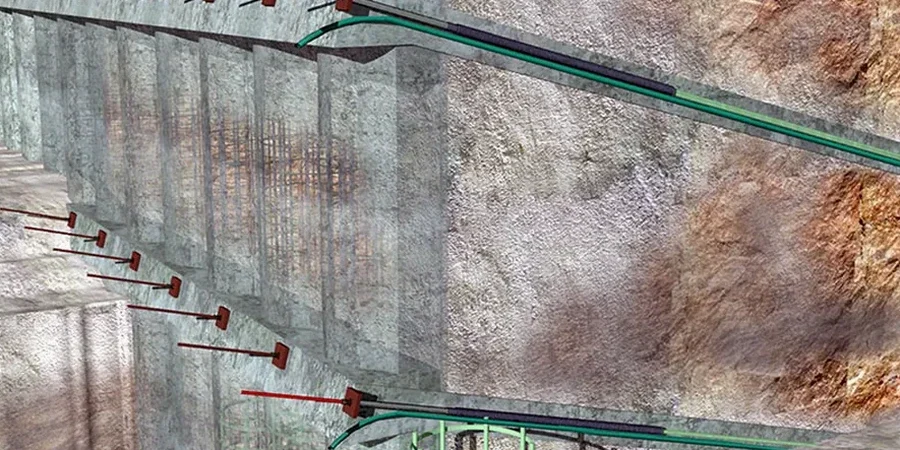
East Bay construction projects face a unique intersection of seismic demand and variable geology. In Hayward, where the Hayward Fault runs directly through the city limits, any retaining structure deeper than a few feet must account for ground displacement and slope creep in the Franciscan Complex bedrock. We apply geotechnical anchor design that treats these conditions as baseline requirements, not special exceptions. By combining deep excavation monitoring data with subsurface profiles from local borings, we size active tiebacks and passive rock anchors to maintain stability in colluvial soils and weathered mélange. This approach matters for commercial developers along Foothill Boulevard and industrial retrofits near the bay, where a miscalculated bond length can cascade into wall deflection and costly remediation.
Anchors in the Hayward fault zone must hold against both static earth pressure and dynamic kinematic loading — designing for one without the other is a liability.
Standards used
IBC 2022 (International Building Code), ASCE 7-22 Minimum Design Loads for Buildings and Other Structures, PTI DC-35.1-14 Recommendations for Prestressed Rock and Soil Anchors, ASTM A416 / A416M Low-Relaxation Seven-Wire Steel Strand, Caltrans Standard Specifications Section 42 - Ground Anchors, FHWA Geotechnical Engineering Circular No. 4 - Ground Anchors and Anchored Systems
Questions and answers
What is the difference between an active and a passive ground anchor?
An active anchor is prestressed to a specified lock-off load immediately after installation, actively compressing the retained soil or structure. A passive anchor is not stressed; it only develops resistance when the structure begins to move and engages the tendon. In Hayward, we use active tiebacks for shoring walls along busy corridors like Foothill Boulevard where we cannot tolerate any lateral deflection, while passive rock bolts are common for slope stabilization where some micro-movement is acceptable.
How much does an anchor design package cost for a Hayward project?
For a typical commercial retaining wall or hillside stabilization project in Hayward, an anchor design package including bond length calculations, corrosion protection details, and load test specifications runs between $1,040 and $3,550, depending on the number of anchor rows and the complexity of the subsurface profile near the fault zone.
How close to the Hayward Fault can you safely install ground anchors?
We design anchors within fault setback zones by incorporating the kinematic loading provisions of ASCE 7-22 and using double-corrosion protection. The California Geological Survey's Alquist-Priolo zone maps define the regulatory setbacks, but the engineering solution involves designing the unbonded length to accommodate fault-related ground deformation without exceeding the tendon's yield stress.
What test is required to verify an anchor's capacity before the wall is built?
We specify a performance test on a sacrificial anchor to 133% of the design load, measuring creep movement over a 10-minute hold at the test load. This confirms the grout-to-ground bond stress used in design matches the actual subsurface conditions. For production anchors, we then run proof tests and lift-off tests on each tendon to verify the lock-off load, adjusting as needed for the soil variability common in Hayward's Franciscan Complex.