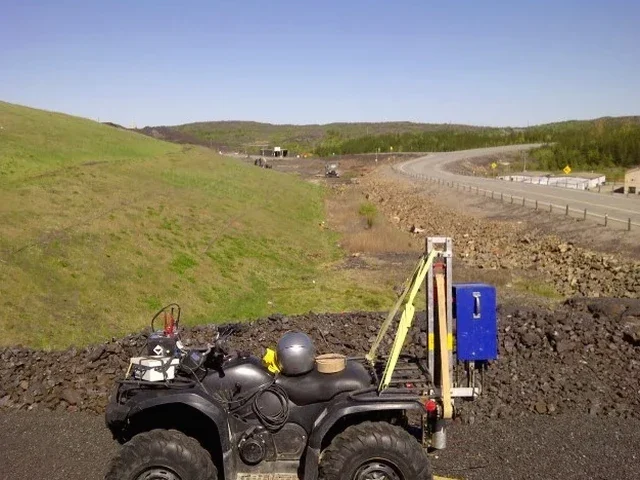
Relying on a single boring to characterize a site within the Hayward Fault Zone is a gamble that leads to expensive change orders. We have seen foundation designs fail plan check because the bedrock profile between widely spaced SPT holes was nothing like the subsurface model. Seismic refraction and reflection tomography eliminate that guesswork: we transmit shear and compression waves across the site array, invert travel times into a continuous 2D velocity cross-section, and deliver a stratigraphic image that shows the true top-of-rock, fracture density, and velocity contrasts that govern site classification under ASCE 7-16 Chapter 20. In Hayward, where Franciscan Complex bedrock can shoal from 80 feet to 8 feet across a single parcel, this continuous profile is not a luxury—it is the difference between a footing design that works and one that requires emergency redesign during excavation. When the Department of Building Inspection asks for Vs30 and Site Class, our tomographic lines provide the measured shear-wave velocity profile without relying on proxy correlations from blow counts alone.
A single tomographic line replaces a dozen borings for mapping bedrock—and does it without disturbing the ground.
Site-specific factors
ASCE 7-16 Table 20.3-1 assigns Site Class based on the average shear-wave velocity in the upper 100 feet. In Hayward, where the active Hayward Fault produces a creeping deformation zone through the Mission Boulevard corridor, misclassifying a Site Class E as a Site Class D can understate the design spectral acceleration by 30 to 50 percent. That error propagates directly into base shear calculations and can result in a lateral force-resisting system that is structurally inadequate for the 475-year earthquake. Seismic tomography eliminates this risk by providing a measured Vs profile—not a correlated one from N-values—along the entire building footprint. The reflection component further identifies blind fault splays, shear zones, and abrupt bedrock steps that a grid of borings could easily miss. For critical facilities (Risk Category III and IV), the City of Hayward requires a site-specific ground motion hazard analysis; our tomographic velocity model serves as the primary input to that analysis, satisfying both the Building Official and the geotechnical peer reviewer on the first submittal.
Questions and answers
How much does a seismic refraction survey cost for a typical Hayward commercial lot?
For a standard commercial parcel in Hayward—typically one or two 230-foot refraction lines with 24 geophones and sledgehammer source—the cost ranges from US$2,440 to US$6,000 depending on site access, line length, and whether S-wave data is acquired in addition to P-wave. Sites requiring a Betsy Seisgun for deeper penetration, traffic control on arterial roads like Foothill Boulevard, or multiple roll-along spreads increase the upper end of the range. Every proposal includes mobilization, acquisition, processing with tomographic inversion, and a stamped report with Vs30 and Site Class determination.
Can seismic tomography detect the exact location of the Hayward Fault trace on my property?
Seismic reflection profiling can identify fault strands, offset reflectors, and velocity discontinuities consistent with faulting, but it does not provide a legal determination of Alquist-Priolo zoning. Our reflection sections have resolved fault splays with throws as small as 3 feet at depths of 60 to 100 feet in the Mission-Foothill area. The results are used by the project geologist to plan exploratory trenches that confirm or rule out Holocene activity. For most projects, the practical value is knowing where the shear zone lies so structures can be set back or designed for differential displacement.
What is the difference between seismic refraction and a MASW survey for getting Vs30?
Refraction tomography measures P-wave and S-wave velocity by picking first-arrival times from body waves that refract along velocity boundaries, giving you a layered 2D model that excels at mapping bedrock depth. MASW analyzes the dispersive properties of surface waves (Rayleigh waves) to produce a 1D Vs profile directly below the array center. For Vs30 determination, MASW often provides higher S-wave resolution in the upper 100 feet, which is why we routinely run both methods on the same spread—refraction for the structural and stratigraphic model, MASW for the most defensible Vs30. In Hayward's alluvial basin, where a stiff clay layer at 30 feet can fool a refraction-only interpretation, the combined approach eliminates the ambiguity.