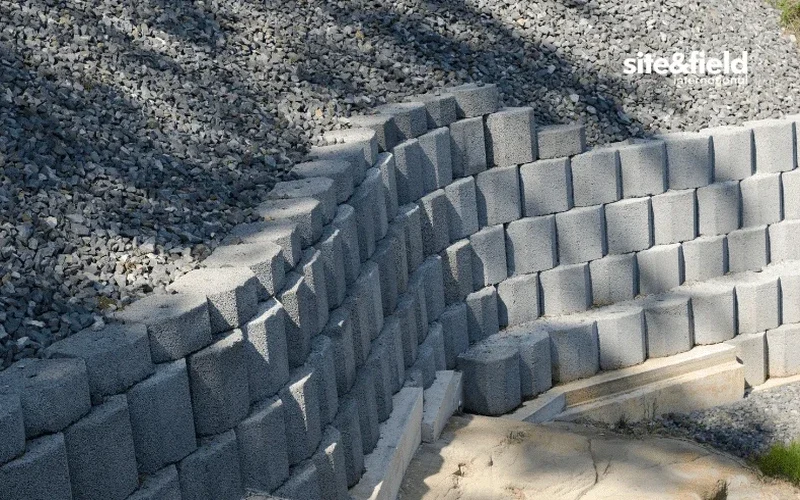
Hayward sits squarely on the Hayward Fault, but the everyday challenge for retaining wall design here isn’t just the seismic hazard—it’s the wildly variable alluvial soils that blanket the flatlands and the clay-rich colluvium draped over the eastern hills. We’ve pulled samples from B Street to the Cal State East Bay hills where the upper five feet can be stiff clay one lot over and loose sandy silt the next. A standard 6-foot wall retaining a driveway cut in the Hayward Hills isn’t a copy-paste detail; it needs a site-specific look at active wedge geometry and drainage because perched groundwater shows up in February right where your heel embedment was supposed to go. When the CPT test logs show a loose lens at 8 feet behind the proposed wall face, we adjust the stem reinforcement before it ever hits a plan checker’s desk.
A Hayward retaining wall isn’t just holding soil; it’s managing a groundwater regime that changes between August drought and January atmospheric river events.
Our approach and scope
The most expensive mistake we see in Hayward is a contractor pouring a cantilever wall with a standard county detail, only to discover six months later that the backfill zone was underlain by an old creek channel fill—soft, compressible, and completely missed because nobody ran a test pit or pushed a boring behind the wall line. Retaining wall design here means verifying the global stability through the foundation soil, not just the internal stem and base. We specify crushed rock drainage blankets with filter fabric because the local silty fines migrate fast and clog weep holes within two rainy seasons. For walls over 10 feet, we tie the stem design to a performance-based displacement target under the ASCE 7-22 seismic load combinations, checking sliding and overturning with a reduced bearing capacity under cyclic loading. The IBC 2021 Chapter 18 parameters we derive from borings drive the numerical model—cohesion, friction angle, and unit weight aren’t generic textbook numbers when you’re holding back a hillside in the Glen Eden neighborhood.
Site-specific factors
We set up the CPT rig on a hillside lot off Carlos Bee Boulevard last spring where the neighbor’s unreinforced block wall had rotated 4 inches out of plumb in only three years. The cause wasn’t poor block work—it was a thin lens of saturated sandy silt at 6 feet depth that nobody had drained. When we ran the numbers for a replacement cantilever wall, we included a heel drain connected to a daylight outlet and bumped the embedment by 18 inches to get below the wet zone. Two months later, the owner called us back—not because of a problem, but because the adjacent lot wanted the same treatment. That’s the Hayward pattern: once drainage is solved, the wall stands. The risk isn’t the earthquake alone; it’s the combination of moderate seismicity with a water table that rises fast in winter, softening the bearing stratum and doubling the lateral thrust if the backfill isn’t free-draining.
Standards used
ASCE 7-22 (Minimum Design Loads for Buildings and Other Structures), IBC 2021 Chapter 18 (Soils and Foundations), ASTM D1586 (Standard Test Method for Standard Penetration Test), ASTM D2487 (Standard Practice for Classification of Soils for Engineering Purposes), Caltrans Standard Specifications Section 19 (Earthwork), ACI 318-19 Chapter 11 (Walls)
Questions and answers
How much does a retaining wall design for a Hayward residential project typically cost?
For a single-family hillside lot in Hayward, a complete retaining wall design package—including site exploration, laboratory testing, and the engineering calculations and stamped drawings—generally falls between US$1,060 and US$3,590. The spread depends on the wall height, whether surcharge loads from an uphill structure are involved, and the number of borings or CPT soundings needed to characterize the backfill zone.
Does Hayward require a geotechnical report for retaining walls under 4 feet?
Hayward follows the California Building Code, which typically triggers a geotechnical investigation for walls over 4 feet measured from the bottom of the footing to the top of the wall, or for any wall supporting a surcharge. Even below that height, if the wall is in a seismically active zone or adjacent to a property line, the building official often requests a site-specific report. We’ve seen it enforced consistently on hillside parcels east of Mission Boulevard.
What seismic coefficient do you use for Hayward walls?
We derive the horizontal seismic coefficient (kh) from the ASCE 7-22 mapped spectral accelerations for the site’s latitude and longitude, adjusted for Site Class D or E—Hayward is predominantly Site Class D alluvium with pockets of Class E near the bay. Typical kh values range from 0.15 to 0.22 for a pseudo-static analysis, and we apply that to the active wedge using the Mononobe-Okabe method to compute the seismic increment of earth pressure.
Can you design a retaining wall if the neighbor’s property is only 3 feet from the excavation?
The reference range for this service in Hayward is US$1.060 - US$3.590. The final price depends on the project scope and volume.