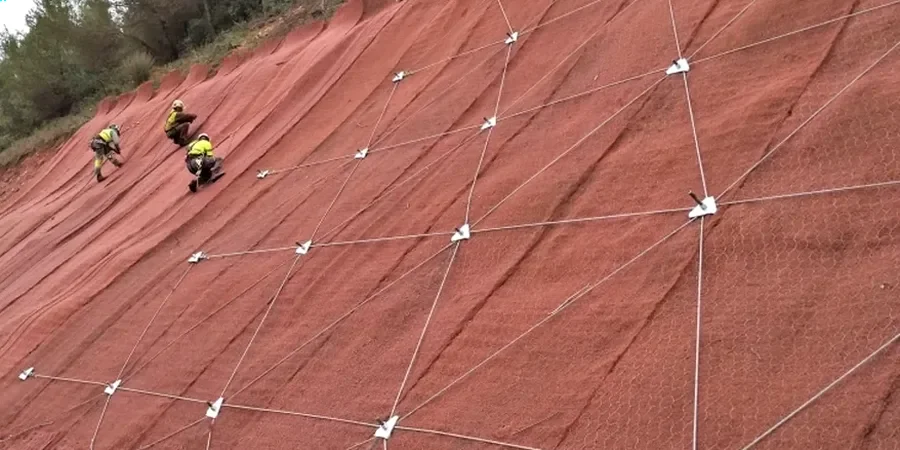
In Hayward, the hills don't just rise steeply—they move. We've mapped multiple slow-creep landslides along the Mission Boulevard corridor where the sediment meets the bedrock, and the failure rate spikes two to three years after heavy winter rain cycles. A slope stability analysis here starts with logging the contact between weathered Franciscan melange and overlying alluvial fans; miss that interface by half a meter and the factor of safety calculation means nothing. Most cut slopes above Cal State East Bay sit on 20° to 35° inclinations, right in the range where pore-pressure buildup triggers shallow translational slides. We combine SPT drilling to bracket shear strength with inclinometer data from the first wet season—that dual approach catches movement before cracking appears at the pad.
A slope can look stable for ten years and fail in one wet March—we measure the pore pressure that triggers it, not just the geometry.
Our approach and scope
The soil profile varies block by block in Hayward. Up in the Fairview district, slopes cut into stiff clayey colluvium with plasticity indices above 25; down toward Tennyson Road, the profile flips to silty sand lenses that drain fast but lose cohesion when saturated. A slope stability analysis has to reconcile both materials because a single design section won't cover a project that spans two geologic units. We run consolidated-undrained triaxial tests on Shelby tube samples from the clay zone, then back-calculate the drained friction angle from standard penetration data in the sandier layers. For deep failures that daylight near BART track embankments, we tie the analysis to a
retaining wall design check—the global stability envelope includes the wall's heel, not just the slope face.
Key parameters we pin down for every Hayward hillside include: peak and residual friction angle, pre-failure pore pressure ratio (ru), depth to the weathered bedrock surface, and the geometry of any pre-existing shear surfaces mapped during the site walk. On sites within 2,000 ft of the Hayward Fault trace, we also factor in a 0.15g to 0.25g horizontal acceleration for pseudo-static analysis per ASCE 7-22 Chapter 11.
Questions and answers
What does a slope stability analysis cost for a single-family lot in Hayward?
For a typical hillside lot with one primary slope section, the analysis ranges from US$1,330 to US$4,060 depending on the number of borings, laboratory tests, and whether pseudo-static seismic runs are required. Sites within the Hayward Fault Alquist-Priolo zone usually need the full suite, which pushes toward the upper end.
How do you account for the Hayward Fault in the stability model?
We apply a horizontal pseudo-static coefficient (kh) derived from the ASCE 7-22 probabilistic ground motion maps for the site's coordinates and site class. For slopes within 2 km of the mapped trace, kh typically falls between 0.15g and 0.25g. The analysis runs both static and pseudo-static cases so the engineer sees exactly how much margin the seismic load consumes.
Can you analyze an existing landslide that has already moved?
Yes—that is a reactivation analysis. We map the pre-existing slip surface with inclinometers or SPT refusal depth, then run the model with residual friction angles (often 8° to 14° for Franciscan clay seams). The goal is to define the groundwater threshold that re-triggers movement and size a stabilization measure against it.
What stabilization options do you design based on the analysis?
The analysis identifies whether the failure mechanism is shallow (1–3 m deep, treatable with subsurface drainage and buttressing) or deep-seated (6 m+, often requiring tied-back retaining walls or shear keys). We provide the geotechnical design parameters—drained friction angle, cohesion intercept, and pore-pressure ratio—that the structural engineer needs for final wall or anchor design.
How long does the field and lab work take before the report is ready?
Field drilling and instrument installation typically take 3 to 5 days on a Hayward hillside lot. Laboratory triaxial and ring shear tests run 3 to 4 weeks due to consolidation and slow shearing stages. The draft stability report follows within 10 business days after lab data is complete—so plan on roughly 6 to 7 weeks total from mobilization to final submittal.