← Home · Underground Excavations

Soft Ground Tunnel Analysis in Hayward: Geotechnical Approach for the Bay Mud Challenge

Together, we solve the challenges of tomorrow.

LEARN MORE →

The first thing our crew unloads at a Hayward site is usually the CPT rig. Pushing a cone through the upper 40 to 80 feet of Young Bay Mud gives us a continuous profile before anyone picks up a shovel. Hayward sits squarely on the San Francisco Bay Plain, where Holocene deposits of silty clay and loose sand alternate across the flatlands west of the Hayward Fault. We sample with thin-wall Shelby tubes and run density logs because the transition from desiccated crust to normally consolidated clay can shift by 15 feet across a single block. Once the stratigraphy is clear, we combine that data with CPT testing to map undrained shear strength trends, and we cross-check the profile with test pits where the tunnel alignment passes through weathered alluvium near the fault trace.

The difference between a stable tunnel and a sinking one in Hayward is often 15 feet of desiccated crust we didn't map.

Our approach and scope

IBC Chapter 18 and ASCE 7-22 set the framework, but in Hayward the governing concern is the long-term settlement of soft clay under tunnel lining loads. We classify every sample per ASTM D2487 and run consolidation tests to capture the compression index of the plastic silts that dominate the bay plain. The Hayward Fault creates an additional demand: ground displacement history influences the preconsolidation pressure profile, so we measure pore pressure dissipation during CPT stops and calibrate effective stress parameters in the triaxial cell. For projects that extend into the stiffer Merritt Sand or the alluvial fans near the Hayward Executive Airport, we pair SPT drilling with downhole shear-wave velocity measurements to build a stiffness model that feeds directly into the finite-element mesh.
Soft Ground Tunnel Analysis in Hayward: Geotechnical Approach for the Bay Mud Challenge
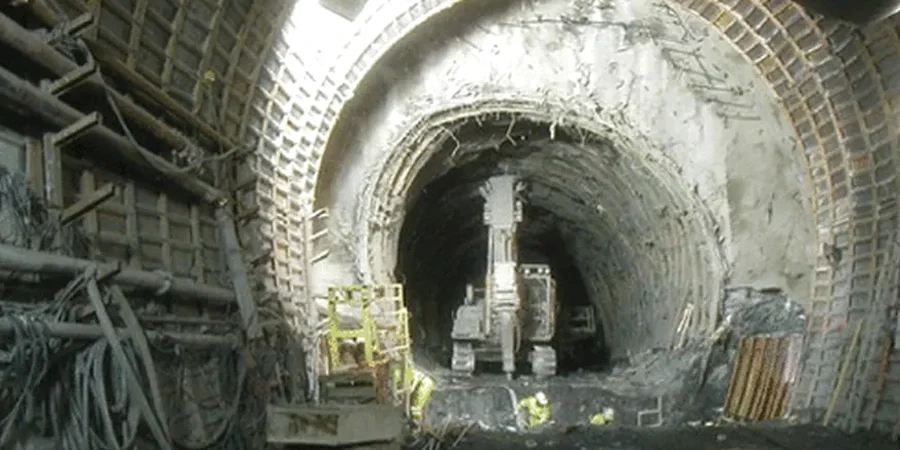
Technical reference image — Hayward

Site-specific factors

The mistake we see repeatedly in Hayward is treating the entire soft-clay column as a single homogeneous layer in the numerical model. The upper desiccated crust carries a higher undrained strength and a lower compressibility than the underlying normally consolidated mud: ignoring that distinction produces a lining design that is too stiff, concentrates stress, and actually accelerates settlement at the springline. Another common error is neglecting the pore-pressure buildup during excavation in low-permeability bay clay. Without a coupled consolidation analysis, the contractor gets a dry tunnel in the model and a wet, squeezing face in the ground. We run dissipation tests during CPT soundings and feed the consolidation coefficient directly into the time-dependent deformation analysis so the construction sequence matches the drainage reality of Hayward's fine-grained profile.

Need a geotechnical assessment?

Reply within 24h.

Email: info@geotechnicalengineering1.com

Technical parameters

ParameterTypical value
Undrained shear strength (Su) range, Bay Mud200 – 800 psf (upper 40 ft)
Compression index (Cc) typical range0.35 – 0.75
Sensitivity (St) of intact clay3 – 8 (moderate to high)
Overconsolidation ratio (OCR) crust2.0 – 4.5 (upper 10–15 ft)
Permeability, silty clay matrix1×10⁻⁷ to 5×10⁻⁹ cm/s
Depth to Merritt Sand (east of fault)25 – 60 ft below surface

Complementary services

01

Field Characterization and Sampling Program

We deploy CPTu rigs with pore-pressure measurement, collect Shelby tube samples at critical depth intervals, and run downhole seismic tests to capture the small-strain shear modulus. Every boring log is tied to the Hayward coordinate grid so the stratigraphy references the known bay-plain depositional sequence.

02

Laboratory Testing and Constitutive Model Calibration

Consolidation, triaxial compression, and index testing per ASTM standards. We calibrate the Modified Cam-Clay or Hardening Soil model parameters directly from lab curves so the numerical analysis reflects the real pore-pressure response and creep behavior of Hayward Bay Mud.

Applicable standards

IBC 2024 (Chapter 18 – Soils and Foundations), ASCE 7-22 (Minimum Design Loads for Buildings and Other Structures), ASTM D1586 (Standard Test Method for Standard Penetration Test), ASTM D2487 (Standard Practice for Classification of Soils for Engineering Purposes), ASTM D2435 (One-Dimensional Consolidation Properties of Soils), ASTM D5778 (Standard Test Method for Electronic Friction Cone and Piezocone Penetration Testing)

Questions and answers

How much does a geotechnical analysis for a soft ground tunnel in Hayward typically cost?

For a tunnel alignment study in Hayward, the geotechnical analysis typically ranges from US$4,600 to US$18,590. The final cost depends on the length of the alignment, the number of CPT soundings and borings required, and the complexity of the laboratory program. A short pedestrian tunnel crossing a single soft-clay unit will fall at the lower end; a longer alignment that crosses the Hayward Fault zone and requires triaxial testing with pore-pressure measurement moves toward the upper bound.

What makes Bay Mud in Hayward different from soft clay in other parts of the Bay Area?

Hayward's Bay Mud sits west of a very active fault strand, so the sedimentation history includes episodes of ground shaking and possible preconsolidation from seismic events. We often find a stiffer desiccated crust and a more pronounced sensitivity (remolded strength loss) than in San Jose or Foster City. The proximity to the fault also means shear-wave velocity profiles can change sharply within a few hundred feet, which directly affects the dynamic stiffness used in tunnel-soil interaction models.

Do you need consolidation testing for a shallow utility tunnel in Hayward, or is CPT data enough?

If the tunnel invert stays within the desiccated crust, CPT data combined with pocket penetrometer readings may be sufficient for a preliminary assessment. As soon as the excavation reaches the normally consolidated zone below about 15 feet, consolidation testing becomes necessary. We have seen utility tunnels settle 4 to 6 inches over five years when the design relied on undrained parameters alone, without accounting for the time-dependent compression of the deeper clay.
Location and service area

We serve projects in Hayward and surrounding areas.

View larger map