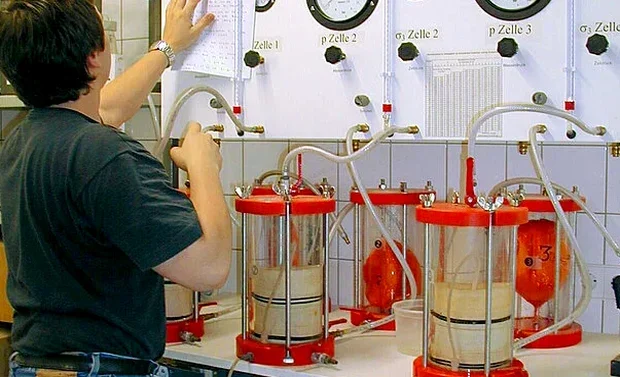
ASTM D1883 forms the backbone of pavement design in California, and in Hayward its relevance is amplified by the local geology. The city sits on alluvial fan deposits from the Hayward Hills, with soils ranging from stiff clays to silty sands, all influenced by the nearby Hayward Fault. A laboratory CBR test measures the bearing capacity of these materials under controlled moisture and density conditions, giving engineers a repeatable benchmark for subgrade strength. Unlike field CBR readings that fluctuate with weather and compaction effort, the lab procedure removes variables so the design number is reliable. For projects along Mission Boulevard or in the industrial corridors near the San Mateo Bridge approach, that reliability translates directly to pavement sections that last. Our team runs the soaked CBR protocol as standard, simulating the worst-case scenario when winter rains saturate the ground, because in Hayward that saturation condition often governs the design. When the subgrade shows marginal CBR values below 5%, we frequently recommend a supplemental stone columns evaluation to assess whether ground improvement can raise the bearing capacity before placing the structural section.
The soaked CBR value in Hayward's clayey alluvium typically controls pavement design, not the dry-weather number.
Site-specific factors
Hayward's location along the Hayward Fault introduces a risk that goes beyond routine pavement distress. Alluvial soils in the flatlands between the hills and the bay, particularly in the vicinity of Highway 92 and the Union City border, contain lenses of saturated fine sand and low-plasticity silt. During a seismic event, these materials can lose strength through liquefaction, and a subgrade that tested at CBR 10 in the lab can drop to near zero in the field when pore pressures spike. The laboratory CBR test alone does not capture this dynamic behavior, so for critical roadways and industrial yards we advise coupling the pavement design with a liquefaction analysis that evaluates the cyclic stress ratio and factor of safety against triggering. The California Geological Survey has mapped much of western Hayward as having moderate to high liquefaction susceptibility, and ignoring that mapping leads to pavements that rut and crack within a few years of construction. Even without liquefaction, the expansive potential of clay strata in the Hayward Hills can cause differential heave that destroys pavement joints, making swell measurement during the soaking phase of the CBR test a vital piece of the design data package.
Questions and answers
What does a laboratory CBR test cost in Hayward?
A standard laboratory CBR test program, including compaction curve and three soaked CBR specimens, generally runs between US$120 and US$190 per sample, depending on the number of points and whether additional index testing is bundled.
How long does the lab CBR test take from sample delivery to report?
The soaking period alone takes 96 hours per ASTM D1883, and with specimen preparation, compaction, and data reduction the full turnaround is typically seven to eight business days. We can expedite reporting for an additional fee when project schedules demand it.
Do you need undisturbed samples for the laboratory CBR test?
No, the CBR test uses remolded specimens compacted to a target density and moisture content. We do need representative bulk samples of the subgrade material, typically 50 to 80 pounds per soil type, taken from the depth that will serve as the pavement subgrade.